Mirab
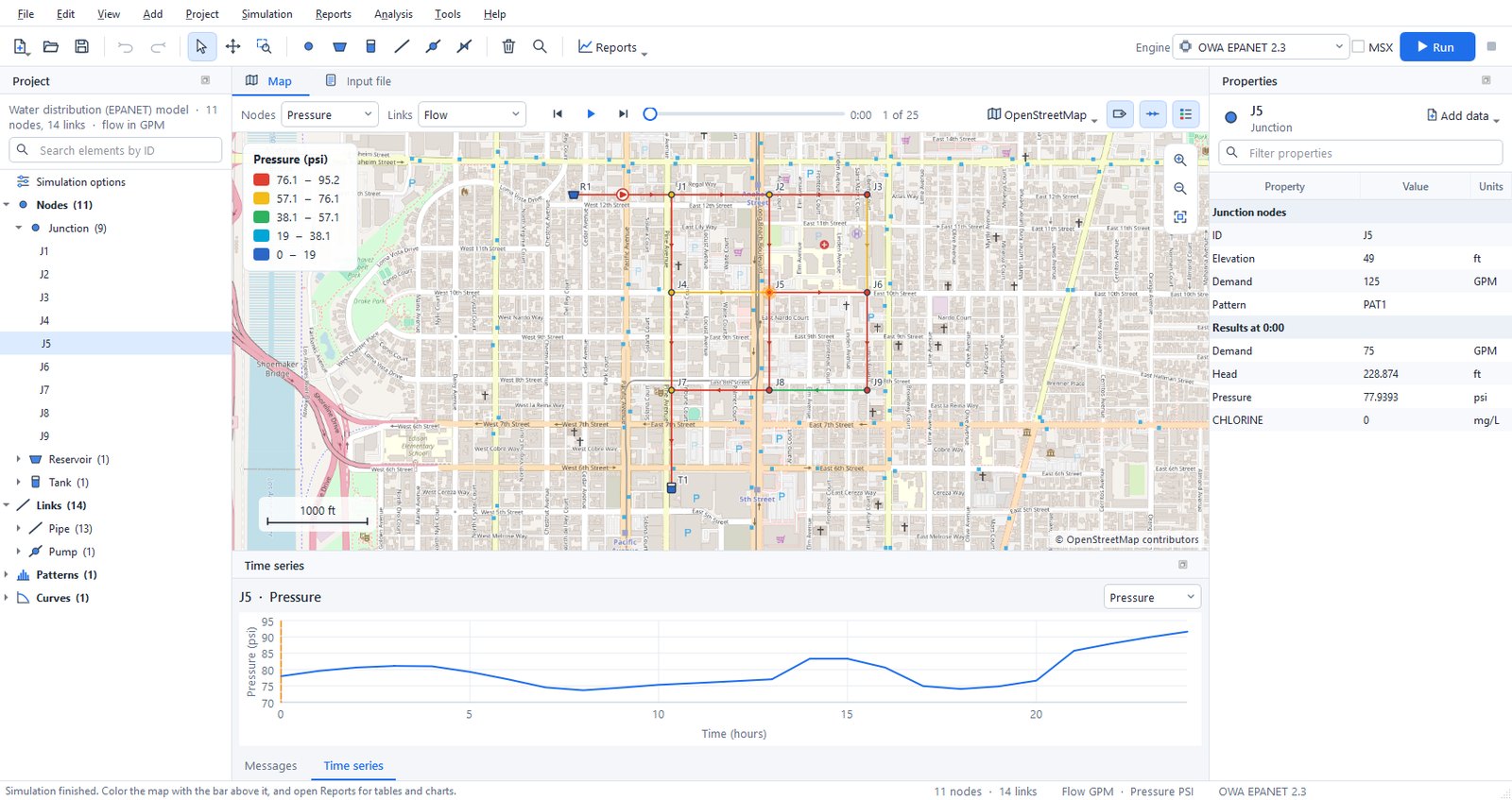
Water distribution and stormwater modeling in one free desktop application. Pick EPANET, SWMM or SWMM5+ from a list and keep working in the same project, on the same map, with the same tools. Mirab runs on Windows, macOS and Linux and needs no other software.
Engines
| Engine | Use it for | Provider |
|---|---|---|
| EPA EPANET 2.2 | Regulatory-standard pressurized network hydraulics and water quality | U.S. EPA |
| OWA EPANET 2.3 | Pressure-driven demand, FAVAD pipe leakage, PCV valves, extra units | Open Water Analytics |
| EPANET-MSX 2.0 | Multi-species reactions, on top of either EPANET engine | U.S. EPA |
| EPA SWMM 5.2 | Urban drainage, runoff, hydraulics and pollutants | U.S. EPA |
| SWMM5+ 1.0 | Finite-volume dynamic-wave routing (optional add-on) | CIMM, UT Austin |
Mirab checks each project against the engine you choose and tells you what that engine ignores or cannot run. Simulations run in a separate process, so a solver crash never closes the application, and every engine can be paused, resumed or stopped with its partial results kept. See Engines and compatibility.
What you can do
-
Build and edit models
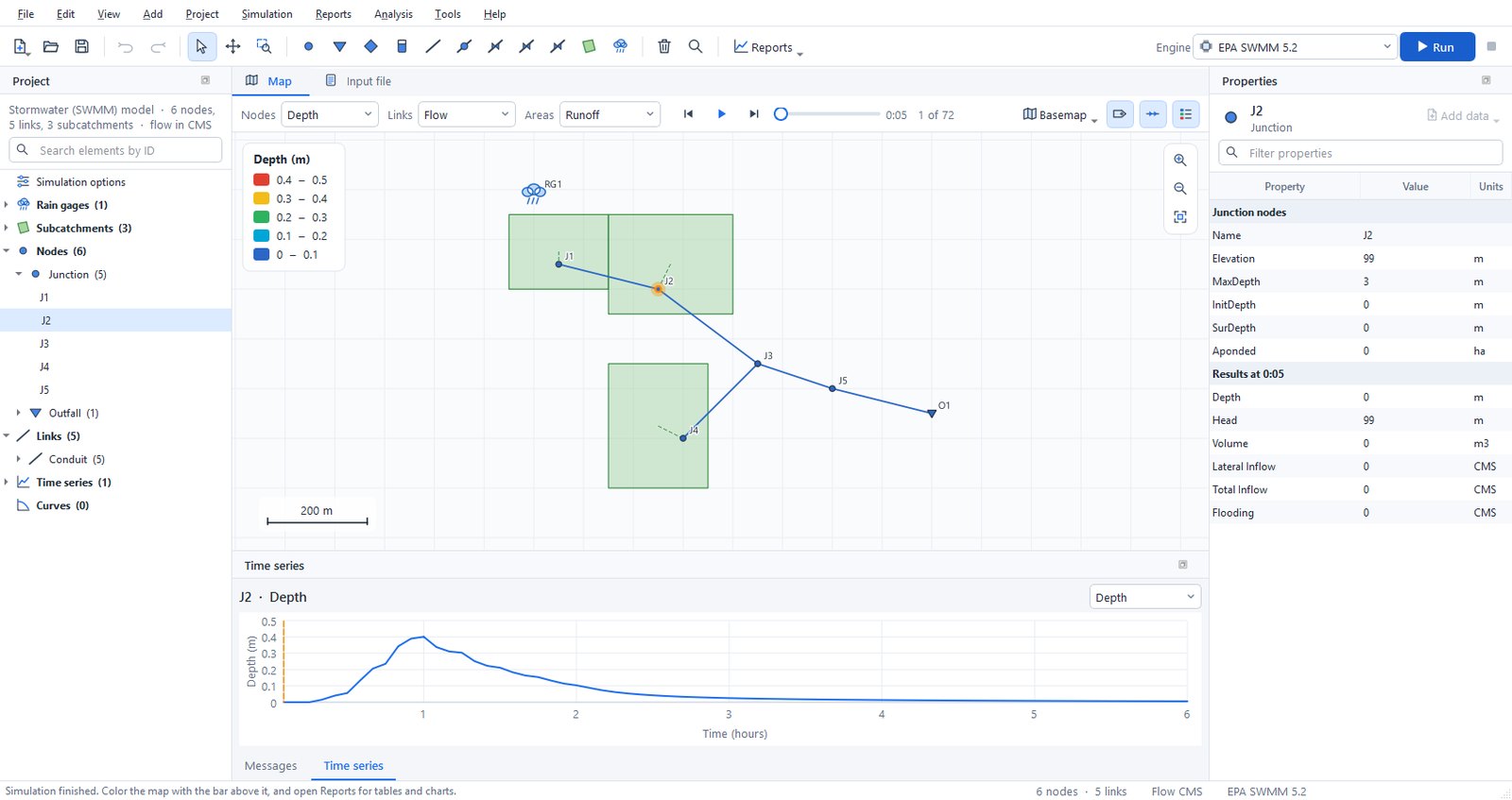
Junctions, tanks, pipes, pumps and valves for EPANET; junctions, outfalls, storage, conduits, subcatchments and rain gages for SWMM. Forms and dedicated editors cover every part of a SWMM model, from pollutants to LID controls and control rules.
-
Watch results as the engine runs
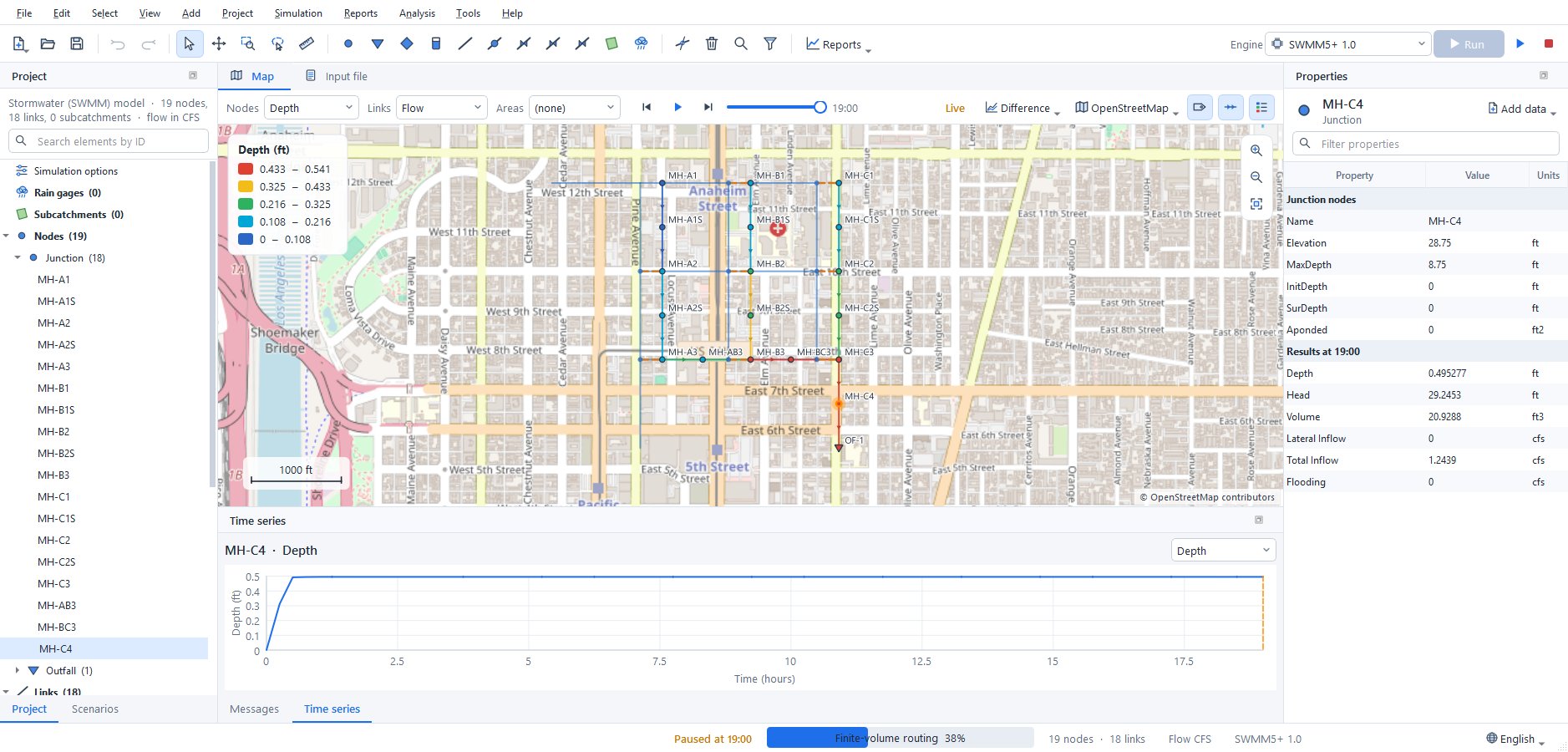
The map, time slider and charts fill in while the simulation runs. Color the network by any result, show flow arrows and animate the time steps.
-
Work on real maps
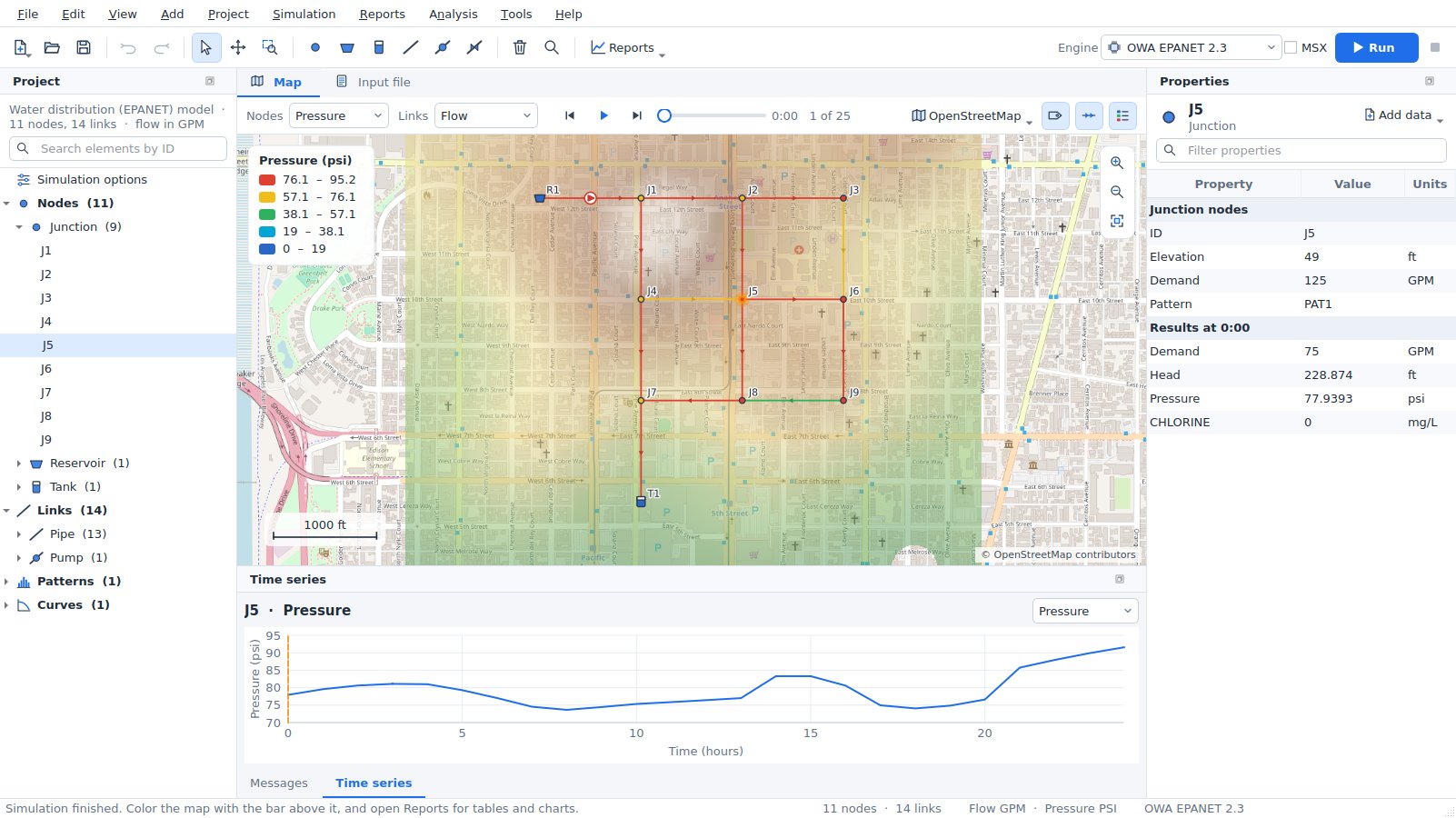
OpenStreetMap, satellite and topographic basemaps or your own WMS and WMTS services, about 1,950 coordinate systems, and GeoTIFF elevation models that set node elevations.
-
Select and trace
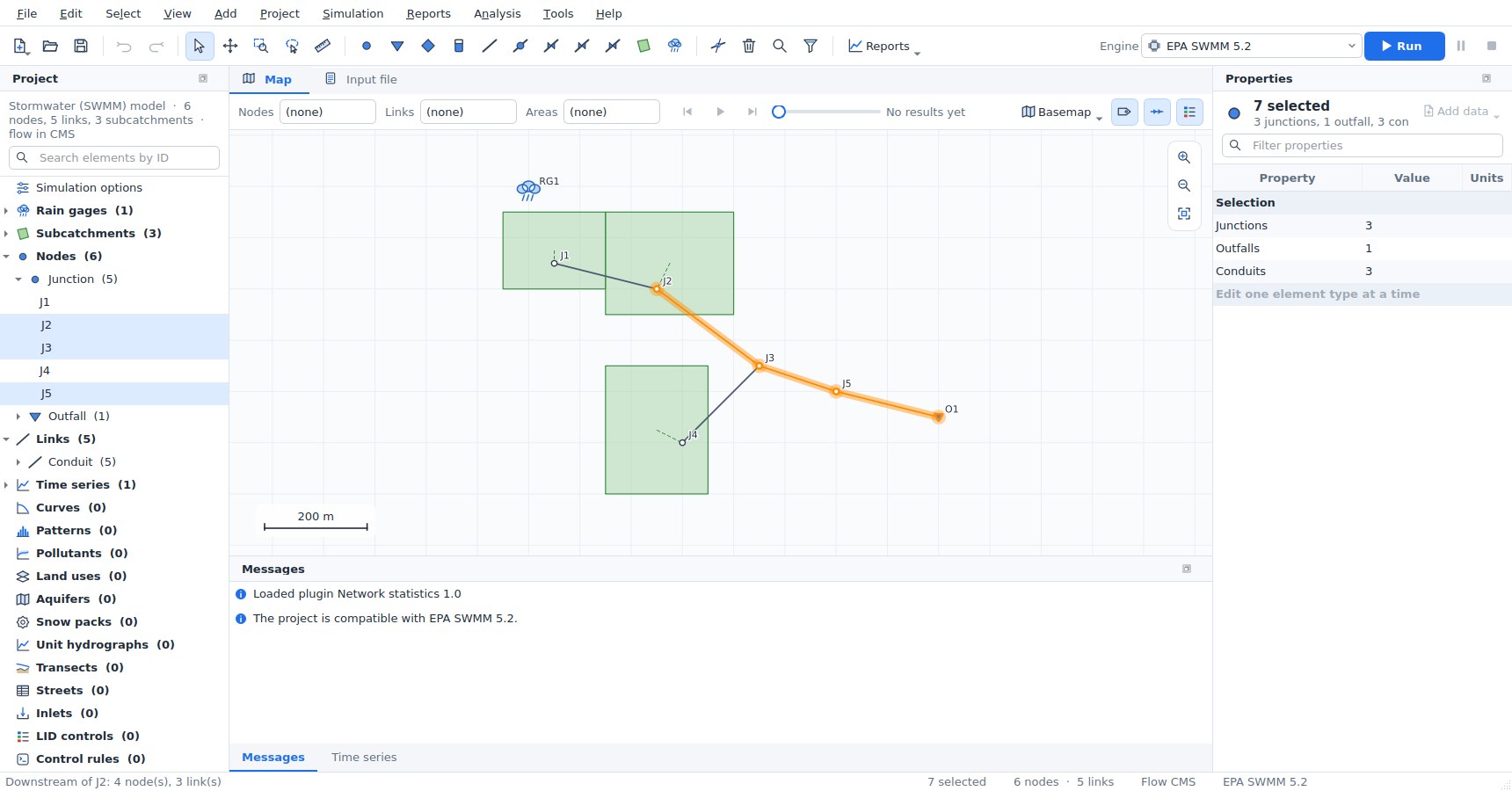
Rectangles, polygons and queries such as
Diameter < 200 AND Pressure < 20; upstream and downstream traces, shortest paths and editing of many elements at once. -
Calibrate
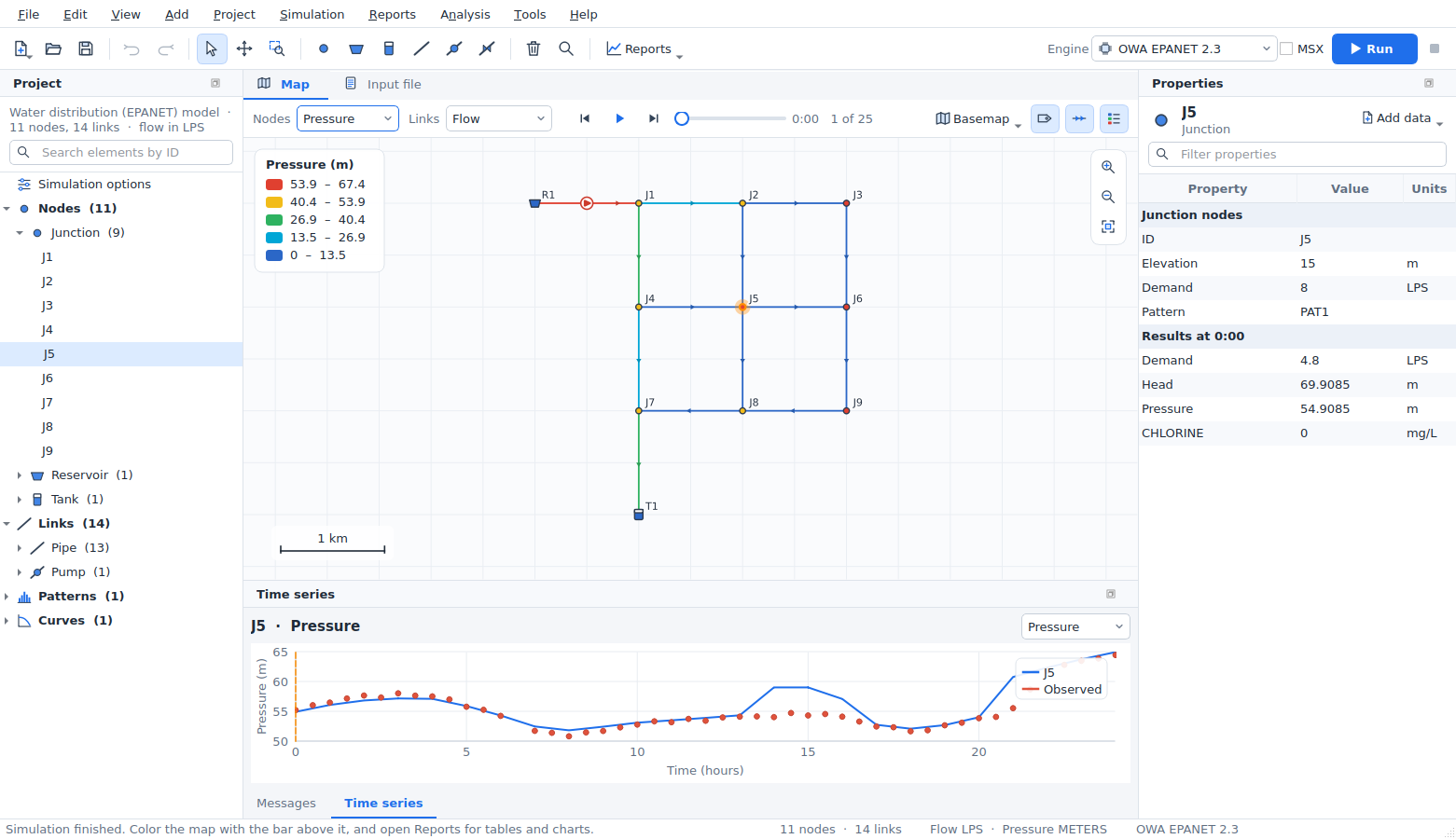
Load field measurements, see NSE, KGE, PBIAS, RMSE and R² per series, and let Mirab search roughness, imperviousness or any other parameter automatically.
-
Compare scenarios
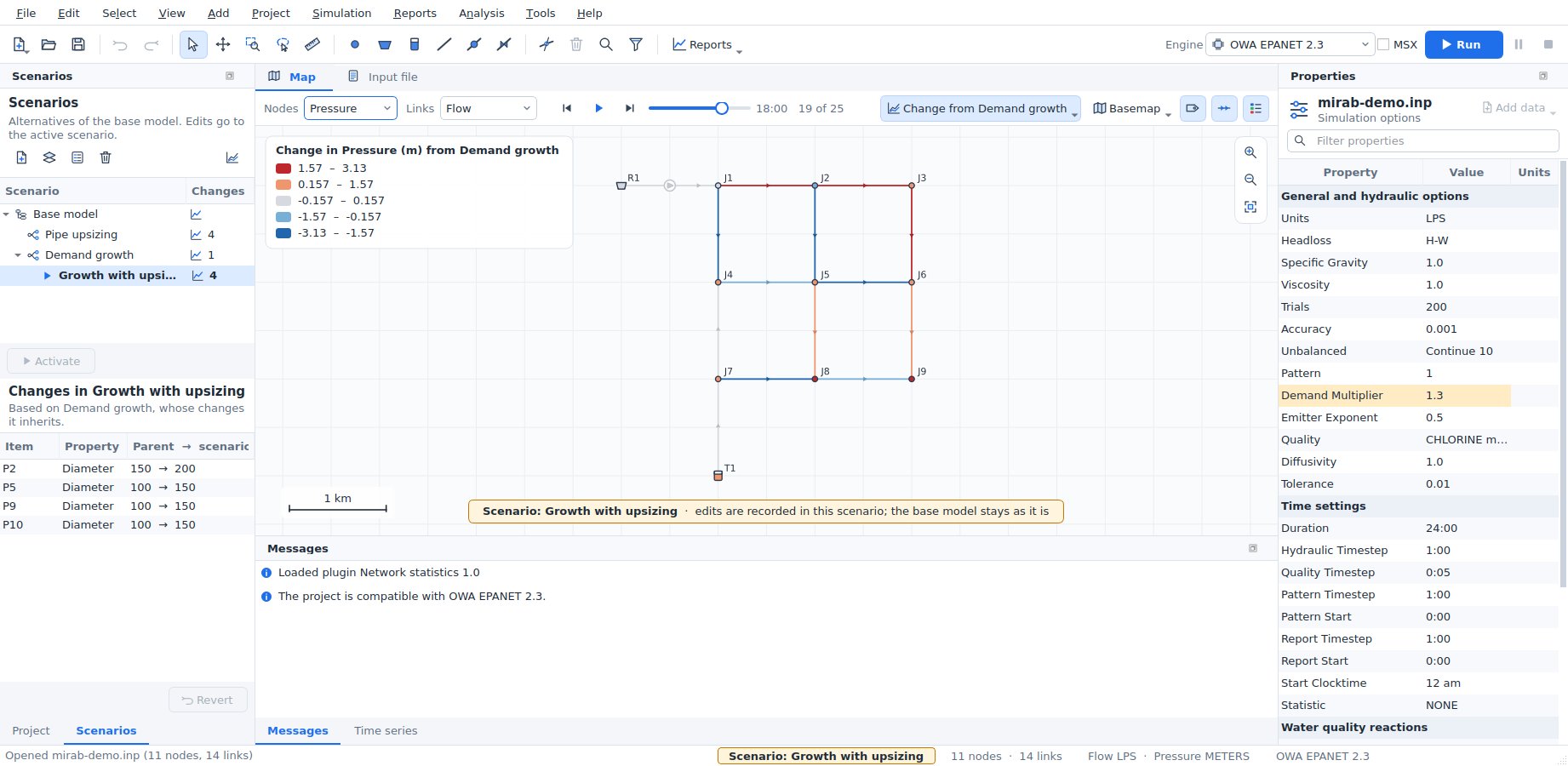
Store pipe upsizing, demand growth or a larger storm as changes to the base model, run several at a time and compare them in a report and on a difference map.
-
Report and deliver
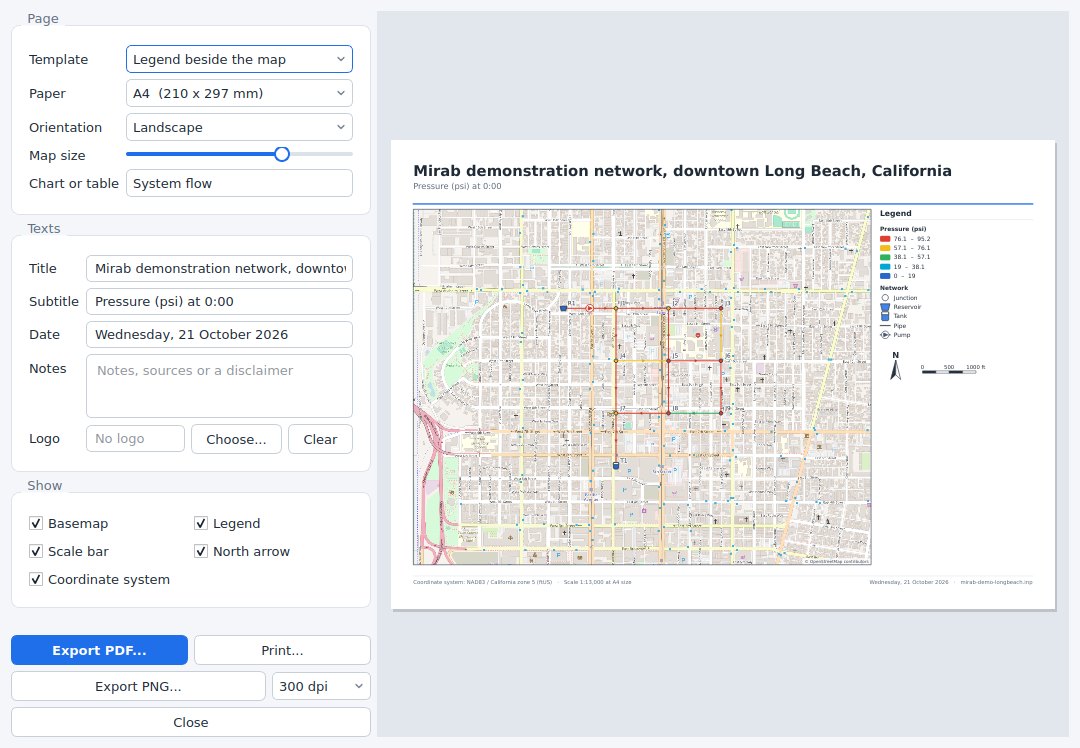
Tables, time series, profiles and flow balances that export CSV; print layouts, PDF or HTML report documents and animated GIFs of the results.
-
Water and wastewater together
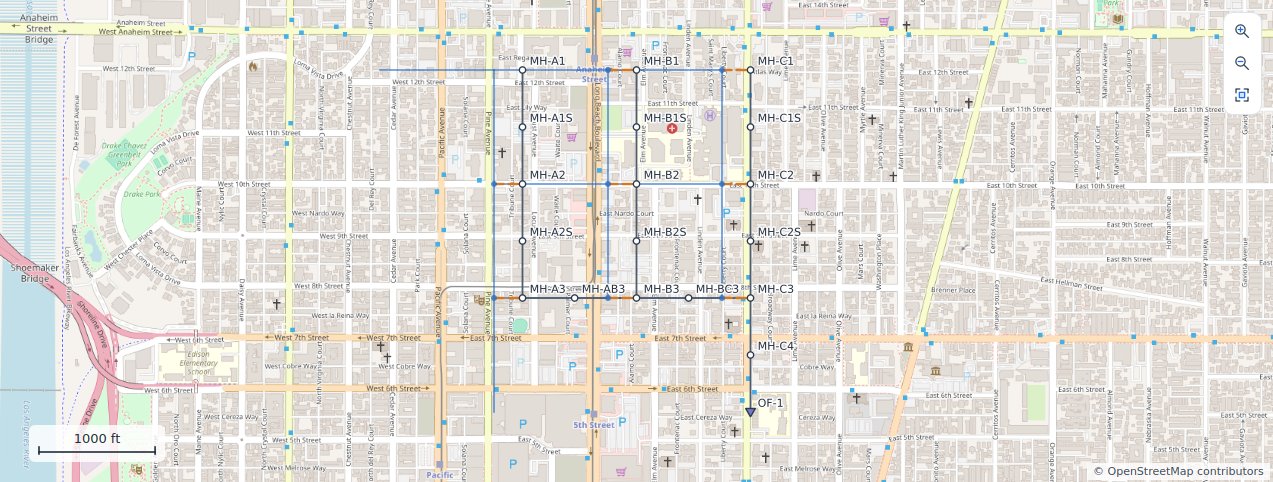
Turn the water use of an EPANET model into dry-weather inflows of a SWMM model of the same area, with return factors and patterns.
Also in Mirab
- Resilience tools: Todini index, water service availability, bridges and articulation points, pipe criticality and fire-flow capacity. See Resilience tools.
- Data exchange: shapefiles, DXF and CSV import; GeoPackage, GeoJSON and WNTR JSON export; "Open in QGIS" in one step.
- The input file stays the master copy: Mirab writes standard EPANET and SWMM files and keeps every comment and line you did not change.
- Scripting: every capability is available from
mirab-cli, with JSON output, and from themirabPython package. See Command line and Python scripting. - Your language: English, Persian, Arabic, Hebrew, Spanish, Brazilian Portuguese, French, Italian, German, Simplified and Traditional Chinese.
Free software
Mirab is licensed under the GNU General Public License, version 3 or later. The simulation engines keep their own licenses. Report problems and suggest features in Issues; contributions are welcome as pull requests, and everyone who has helped is named in AUTHORS. To cite Mirab, use 10.5281/zenodo.23679047, which always points to the latest version; each release has its own DOI on Zenodo. Mirab is not affiliated with or endorsed by the U.S. EPA, Open Water Analytics or CIMM.